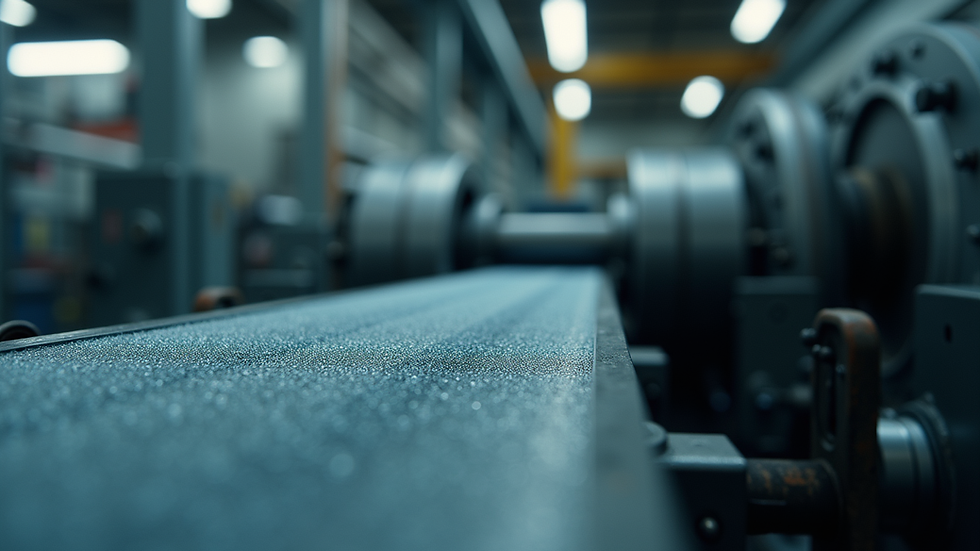
Innovative Slot Die Coating for Sodium Battery Manufacturing and Renewable Energy Production
Updated: May 4
The shift toward sustainable energy solutions has accelerated the demand for efficient manufacturing processes in renewable energy sectors. Sodium battery manufacturing, a promising alternative to lithium-ion technology, requires precise and reliable coating methods to ensure product quality and performance. Slot die fluid coating tooling equipment plays a crucial role in this process by delivering uniform layers of active materials essential for sodium renewable energy devices. This article explores how slot die coating technology supports sodium battery production and renewable energy manufacturing, highlighting practical applications and benefits for process engineers and production managers.
Understanding Slot Die Fluid Coating Technology
Slot die coating is a technique that deposits thin, uniform layers of fluid materials onto substrates. It uses a precision-engineered die with a narrow slot through which the coating fluid flows. The substrate moves beneath the die, allowing the fluid to spread evenly and form a consistent film. This method offers several advantages over other coating techniques:
High precision and uniformity: Ensures consistent thickness across large areas.
Material efficiency: Minimizes waste by controlling fluid volume.
Scalability: Suitable for both pilot-scale and high-volume production.
Process control: Allows adjustments to coating speed, thickness, and fluid properties.
In sodium battery manufacturing, these benefits translate into better electrode quality, improved battery performance, and reduced production costs.
Role of Slot Die Coating in Sodium Battery Manufacturing
Sodium batteries rely on layered electrodes made from active materials coated onto current collectors. The quality of these coatings directly affects battery capacity, cycle life, and safety. Slot die coating tooling equipment enables manufacturers to apply electrode slurries with precise control over thickness and uniformity, which is critical for:
Consistent electrochemical performance: Uniform coatings prevent hotspots and uneven reactions.
Reduced defects: Minimizes pinholes, cracks, and delamination.
Faster drying and curing: Optimized coating thickness supports efficient downstream processing.
For example, a sodium battery producer using slot die coating reported a 15% increase in electrode uniformity and a 10% reduction in material waste compared to traditional doctor blade methods. This improvement helped lower production costs and enhanced battery reliability.
Key Features of Slot Die Tooling Equipment for Renewable Energy Manufacturing
When selecting slot die coating equipment for sodium renewable energy applications, several features are essential:
Adjustable slot width and gap: Allows fine-tuning of coating thickness to match specific electrode designs.
Corrosion-resistant materials: Handles aggressive chemistries found in sodium battery slurries.
Integrated flow control systems: Maintains steady fluid delivery for consistent coatings.
Easy cleaning and maintenance: Reduces downtime and contamination risks.
Compatibility with roll-to-roll systems: Supports continuous production lines for large-scale manufacturing.
These features ensure that the tooling equipment meets the demanding requirements of sodium renewable energy production while maintaining high throughput and quality.
Practical Considerations for Implementing Slot Die Coating
Successful integration of slot die coating in sodium battery manufacturing involves attention to several factors:
Slurry formulation: Viscosity and particle size affect coating behavior; formulations must be optimized for slot die application.
Substrate preparation: Surface cleanliness and tension influence coating adhesion and uniformity.
Process parameters: Coating speed, fluid flow rate, and drying conditions require careful control.
Quality monitoring: Inline sensors and inspection systems help detect defects early.
Process engineers should collaborate closely with equipment suppliers and material scientists to tailor the slot die coating setup to their specific production needs.
Case Study: Enhancing Sodium Renewable Energy Production with Slot Die Coating
A renewable energy manufacturer specializing in sodium-ion batteries upgraded their coating process by adopting advanced slot die tooling. Before the upgrade, they faced challenges with inconsistent electrode thickness and high material waste. After implementing slot die coating equipment with precise flow control and adjustable slot geometry, they achieved:
Uniform electrode layers with less than 3% thickness variation
Material savings of 12% due to reduced overspray and waste
Increased production speed by 20% without sacrificing quality
This case demonstrates how slot die coating technology can directly improve manufacturing efficiency and product performance in sodium renewable energy applications.
Future Trends in Slot Die Coating for Sodium Battery Manufacturing
As sodium renewable energy technologies evolve, slot die coating equipment will continue to adapt. Emerging trends include:
Automation and digital control: Integration of sensors and AI for real-time process adjustments.
Advanced materials compatibility: Coating of novel electrode formulations with complex rheology.
Sustainability focus: Equipment designed to reduce solvent use and energy consumption.
Modular systems: Flexible tooling that can switch between different coating widths and substrates.
These developments will help manufacturers meet growing demand while maintaining high standards of quality and environmental responsibility.
Conclusion: The Future of Sodium Battery Manufacturing
The future of sodium battery manufacturing looks promising. As we continue to innovate in coating technologies, the potential for enhanced performance and sustainability becomes clearer. By leveraging slot die coating, manufacturers can ensure high-quality production that meets the demands of the renewable energy sector. This method not only improves efficiency but also supports the broader goal of advancing sustainable energy solutions.
In conclusion, adopting slot die coating technology is a strategic move for manufacturers aiming to excel in the sodium battery market. The benefits are clear, and the future is bright for those who embrace these advancements.
For more information on how to implement these technologies effectively, consider exploring resources that detail the latest in coating innovations.